Your laundry room shouldn’t be an afterthought.
For most homeowners, laundry is one of the most repetitive tasks in the house, and yet the space where it happens rarely gets the same attention as a kitchen or bathroom. The result is often a room that feels cramped and chaotic. But if you look at it differently, with the right layout, storage, lighting, and fixtures in place, a hardworking laundry room can become one of the most satisfying spaces in your home.
This article provides eight elevated laundry room design ideas that will support daily routines and bring a refined sense of purpose to a room that deserves it.
Quick Answer: What are the Best Laundry Room Design FeaturesThe most effective laundry room design features prioritize function first: an efficient layout, smart vertical storage, dedicated folding surfaces, layered lighting, and thoughtful fixtures. When these elements work together, laundry becomes less of a chore and more of a seamless part of daily life. |
A well-designed laundry room saves time, reduces clutter, and removes unnecessary steps from daily routines.
When the space isn’t designed intentionally, even simple tasks like sorting, washing, folding, and putting away feel more complicated than they need to be. Poor storage leads to piled-up laundry, bad lighting makes stain detection nearly impossible, a missing folding surface means clothes end up on the couch…
Good design eliminates these friction points. And when it’s done thoughtfully, it doesn’t have to sacrifice style for function.
|
Design Priority |
Real-life Outcome |
|
Efficient layout |
Less wasted steps and movement |
|
Smart storage |
Organized and accessible supplies |
|
Dedicated folding surface(s) |
No more “pile on the couch” problem |
|
Layered lighting |
Better visibility for sorting and stain treatment |
|
Quality fixtures |
Better performance and longevity |
|
Ventilation and utility planning |
Prevents moisture damage and ensures code compliance |
The layout of your laundry room determines how efficiently everything else works.
Before selecting cabinets, fixtures, or finishes, think carefully about how you move through the space. The goal is to create a natural workflow: sort, wash, dry, fold, hang, store — without unnecessary doubling back.
Popular Laundry Room Layouts
|
How do you move between sorting, washing, and folding?
Does the door swing interrupt the workflow?
Is there room to add a utility sink without creating congestion?
Getting the layout right first means every other decision (e.g., cabinetry, lighting, fixtures) fits naturally into place.
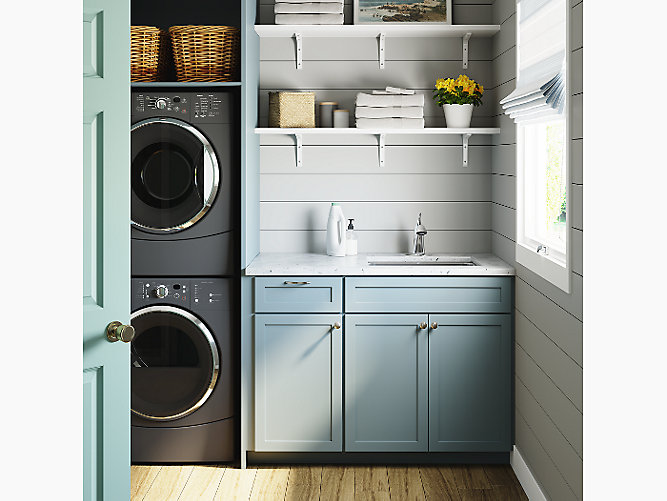
A well-positioned utility sink is great for pre-treating stains, hand-washing delicates, cleaning muddy shoes, filling buckets, and more. Typically, you’ll want to place the sink adjacent to your washer (rather than across the room) to keep the most intuitive workflow.
But not all laundry sinks are created equal, and the fixture you choose will affect both the performance and look of your room.
Deep basin for bulky items
Easy-to-clean surface material (composite or stainless are popular)
A faucet with enough clearance to fill large containers
We recommend exploring Kohler’s utility and laundry sink options. We believe their designs have the best balance between durability and refined aesthetics, so your sink won’t look out of place next to the new cabinetry and other finishes you just put in. Many Kohler sinks also have pull-down faucets, which come in handy when you need to rinse large items or clean the sink itself.
Schedule a free laundry room fixture consultation >>
Vertical storage is the most underutilized opportunity in laundry room design.
Most laundry rooms waste the wall space above and around appliances. Taking a floor-to-ceiling approach to cabinetry and shelving dramatically increases usable storage without expanding the room’s footprint.
Think about what you reach for most often and keep it at eye level or within easy arm’s reach. Items used less frequently, like seasonal storage bags or specialty detergents, can live on higher shelves.
For most homeowners, smart laundry storage solutions look like this:
Upper cabinets with doors to conceal detergents, dryer sheets, and cleaning supplies
Open shelves for baskets or frequently used items
Base cabinets or a lower cabinet with pull-out hamper drawers for sorting
A broom closet-style tall cabinet for mops, ironing boards, and vacuum
Hooks on the back of the door for hanging garment bags or reusable shopping totes
Without a dedicated surface, clean laundry ends up on the sofa, bed, or floor, which can almost defeat the purpose of washing it in the first place. A countertop positioned above a washer/dryer or along an open wall can solve this.
Along an adjacent wall provides generous workspace for folding and sorting multiple loads
With a pull-out ironing board below is an even sleeker space-saving option that will keep your iron off the floor too.
What’s the Best Countertop Material for Laundry Rooms?Laminate, quartz, and butcher block all work well and can complement most overall design directions. They are easy to clean and durable. |
Hang-drying delicates, dress shirts, and anything that shouldn’t go in the dryer is a regular part of most households’ laundry routines, but most laundry rooms have no place to do it. If you’ve ever draped clothing over a door frame, shower rod, or dining chair, you know what we’re talking about.
Some hang-dry solutions that work well are:
A wall-mounted retractable rod extends when needed and tucks away when not in use
A ceiling-mounted drying rack lifts items up and out of the way
A dedicated hanging cabinet with an integrated rod gives delicates a protected space and keeps them wrinkle-free
Position your hang-dry area near the dryer so items transition directly from the drum to a hanger.
Lighting is usually one of the final touches to a laundry room build or remodel. Many homeowners don’t realize how much lighting affects how well their laundry room functions.
A single overhead fixture will create shadows where you need to see most, like over sorting surfaces, near the washer door, and at the folding counter.
Instead, we recommend trying a layered lighting approach. It will help you catch stains before washing, identify fabric care labels without squinting, and sort colors accurately, especially in the early morning or evening when natural light is limited.
Ambient lighting: Overall lighting that brightens the full room
Task lighting: Under-cabinet lighting above the folding counter or utility sink for detailed work like stain treatment
Accent lighting: LED strip lighting inside open shelving for a finished, elevated look
Planning for lighting early (before cabinets are installed!) ensures fixtures are wired correctly and positioned where they’ll truly be useful.
This is where many laundry room renovations fall short. Maybe the sink faucet is an afterthought, the utility sink is purely functional, or finishes don’t match the rest of the home. Treating fixtures with the same care you’d give a kitchen or bathroom makes a meaningful difference, so be sure to do so.
A quality faucet: Look for a pull-down or pull-out spray head with a high-arc spout for maximum versatility. Kohler’s lineup includes options designed specifically for utility applications that don’t compromise on design.
A utility sink with an integrated overflow: This is a practical safety feature that also signals quality construction.
Thoughtful hardware: Cabinet pulls and knobs in a coordinated finish tie the room together and elevate the overall aesthetics.
Finish consistency matters in the laundry room just as much as any other room. If your home has brushed nickel or matte black throughout, carry that into the laundry room.
A laundry room that isn’t properly ventilated will undermine every other design decision you make.
Moisture from washers and dryers builds up quickly in enclosed spaces. Without proper ventilation, it leads to mildew, peeling finishes, damaged cabinetry, and air quality issues. This is one of the most foundational considerations that’s easy to overlook during the design phase (and costly to correct after the fact!).
How to Ventilate a Laundry Room
|
This is also the right time to think through electrical and plumbing requirements. If you’re adding a utility sink, that means new plumbing rough-ins. If you’re adding a second lighting circuit or a dedicated outlet for an iron, that needs to be accounted for before walls close.
Planning your laundry room infrastructure early and in the right order (before cabinetry and finishes are selected) will help keep your project on schedule and prevent expensive surprises.
Layout and storage are the most impactful features. An efficient workflow where sorting, washing, folding, and hanging flow naturally from one to the next reduces friction more than any single fixture or finish.
Stacking the washer and dryer immediately frees up wall space for a folding counter or full-height storage. Vertical cabinetry, retractable drying rods, and pull-out hamper drawers all maximize a small footprint without making the room feel cluttered.
Moisture-resistant flooring is necessary. Porcelain tile and luxury vinyl plank (LVP) are the most popular choices. Both are durable, easy to clean, and available in a wide range of styles that complement elevated design.
Yes. According to Home Advisor, it may offer a smaller return on investment than kitchen or bathroom remodels, but is still consistently cited as a positive factor by homebuyers. A dedicated laundry room can help your home stand out in a competitive market.
At Infusion, our kitchen and bathroom selection process helps homeowners, designers, and trade professionals select fixtures that perform beautifully and integrate seamlessly. Whether you’re coordinating a utility sink or faucet, choosing cabinet hardware that ties the room together, or exploring Kohler’s laundry collections, we guide every decision with your lifestyle and long-term goals at the center.
We offer:
Expert guidance on fixture selection and coordination
Access to curated, high-performance brands like Kohler
Personalized, high-touch consultations at seven Michigan showroom locations
Ongoing support from first visit to final consultation
Ready to design a laundry space that works for you?